The US wants India to recognise internationally accredited labs, harmonise labelling requirements and the validity period of test reports and certification with global practices, and eliminate retesting requirements.
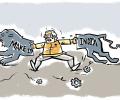
The Department for Promotion of Industry and Internal Trade (DPIIT) has proposed to raise the minimum local content under public procurement order in government contracts. But several local suppliers and multinational companies (MNCs) are saying such a steep target is not attainable. Class-I suppliers, whose goods, services or works offered for procurement has local content equal to or more than 50 per cent may see it hiked to 70 per cent, while it may go up to 50 per cent from 20 per cent for Class-II suppliers.

US President Donald Trump's announcement of 25 per cent tariff on all goods coming from India starting August 1, plus an unspecified penalty, is expected to impact Apple's plans to expand iPhone manufacturing in India as well as export of other electronics to the US. The move comes at a time when Indian electronics production is reeling under pressure due to restrictions imposed by China on supply of several critical components, capital goods and even skilled technology professionals.

The auto ancillary industry - one of the worst hit due to the labour exodus - will need at least three months to get its factories up and running.

Chinese equipment contracts had been given by many public sector undertakings and government companies for their networks, even in sensitive places such as the north east.

COAI has argued that in India the government has been working to keep telecom networks secure, with reviews of the security policy and the insertion of specific clauses into the licences to prevent any risk to network security.

Under these rules, telecom gear makers have to share their source codes and get their equipment tested by third-party labs accredited to the government.

Prime Minister Narendra Modi on Friday said production linked incentive (PLI) scheme, which is aimed at boosting domestic manufacturing and exports, is expected to increase the country's production by $520 billion in the next five years. Addressing a webinar on PLI scheme, organised by Department of Industry and International Trade (DPIIT) and NITI Aayog, through video conference, Modi said the government is continuously carrying out reforms to boost domestic manufacturing. In this year's Budget, about Rs 2 lakh crore was earmarked for the PLI scheme for the next five years and "there is an expectation that the scheme would result in increasing the production by about $520 billion in the next five years", he said. He added that there is also an expectation that the current workforce in the sectors, which will avail the benefits of the PLI scheme, will be doubled and job creation will also increase.

'The huge amount of investments being made by telcos in India for telecom gear, there is no way this demand could be met only by Europeans.' 'The Chinese are quick in installation and offer great value for money.'

Industry associations and companies in the United States, including the US Chamber of Commerce, Coalition of Services Industries and the iconic bike company Harley Davidson have called on the Donald Trump dispensation to push India to reduce tariffs, non-tariffs, and regulatory barriers to boost American exports.

The move comes against the backdrop of the US and some of its allies banning the purchase of Chinese telecom gear over security concerns and pressuring other countries to follow suit.
Huawei willing to place its software code with government.
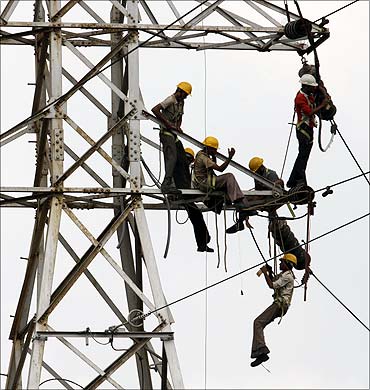
Power transmission infrastructure in 18 major cities could be potentially hacked.

The government on Friday put on hold the preferential market access (PMA) policy that provided for sourcing of sensitive telecom and electronic equipments and technology from domestic manufacturers over security concerns.

Experts say while the increasing demand for a ban on Chinese goods might make for good optics, the reality is that India is still heavily dependent on that country in a wide range of industries like electronics, mobile devices, auto, pharma, telecom equipment, and fertilisers.

The government's ambitious vision document that aims at achieving electronics manufacturing with a value of $300 billion by FY26 (including exports of $105-130 billion) could end up far lower than the target, according to a reality check this month. The reality check came from the Indian Cellular and Electronics Association (ICEA), which partnered with the government in preparing the document. The members of the ICEA are mobile and electronics companies, and its assessment, based on current trends, indicates that the total electronics production in FY26 will be around $225 billion.

The Swadeshi Jagaran Manch has pointed out that these firms pose a threat to domestic manufacturing and retailing as they do not pay relevant taxes such as GST, giving them a huge edge over local players.
Home minister heads several groups of ministers, including the one to decide the revival package for Bharat Sanchar Nigam and Mahanagar Telephone Nigam. His ministry also takes decisive calls on national security in relation to telecom operations as well as equipment and technology used in the industry.

A 15 per cent corporate tax rate for services companies in SEZs, setting up a fund for deep-tech startups and establishing clusters to demonstrate design-to-manufacturing capabilities of tech firms were some of the key demands made by the IT sector at the pre-Budget consultation on Monday. The participants shared their views and suggestions regarding Big Data, incentives for encouraging setting up of data centres, fiscal incentives for data localisation, incentives for pushing digital penetration in rural areas, and corporate guarantee to startups for competing with other nations.

'We have informed the government multiple times that the situation in the US and India are different.' 'Here, there will be a 500 MHz gap in the frequencies which will safely allow aviation without interference.'

The key proposals from the IT industry that were not addressed included removal of dual levies on software products


Importers will now have to provide sufficient proof to the domestic customs authorities that the goods being imported have a minimum 35 per cent value addition in the country from which it is being exported to India.

The Telecom Regulatory Authority of India (Trai) has directed the Cellular Operators Association of India (COAI) to make a presentation detailing the pros and cons of the controversial Indian 5G standard, also known as 5Gi, which the government has been pushing for. The move comes after serious differences emerged among telcos with regard to the technology's efficacy and implementation.

The Ministry of Home Affairs in the past has raised concerns on increasing FDI in telecom sector.

The US has been, historically, a sleeping partner in India-China relations. Today, any attempt by the Modi government to make a bilateral move to improve relations with Beijing could upset Biden's apple cart, notes Ambassador M K Bhadrakumar.

Foxconn is the world's largest contract manufacturer for electronic goods and makes iPhones for Apple and smartphones for its Chinese rival Xiaomi.

The rupee is currently hovering around Rs 65/USD at 2-year lows.

Appropriate policies will increase connectivity much more than spectrum auctions, says Shyam Ponappa.

Assocham president Niranjan Hiranandani said his talks with government officials showed dues to industry and states were pending in the form of refunds of income tax, value-added tax, and GST, and compensation, payments to discoms in the power sector, fertiliser subsidies, etc.

'Our strategy should be to 'hold the line' in the north on the Sino-Indian land frontier, but maintain and, if possible, enlarge India's current edge in the maritime south.'

Maharashtra Chief Minister Uddhav Thackeray announced a statewide curfew for 15 days from 8 am on April 14 to contain the rapid spread of the coronavirus in its second wave. With Section 144 being imposed across the state, Thackeray essential services have been exempted from the restrictions. The curfew will be in place till 7 am on May 1.

Analysts say it is a case of over-promise and under-delivery.

Beijing wants assurance that its investments won't come under scrutiny

The American influential IT and telecom industry sought intervention of the Obama Administration against what they alleged are "discriminatory" Indian policies, which they claimed has resulted in several hundred millions of dollars of losses in the last quarter.
India must change approach and have better access to networks to fulfil its digitisation dream.

India Inc has few leaders who are likely to grab headlines in 2015.

Drones are being sold by e-retailers like Flipkart and Snapdeal for less than Rs 40,000 apiece.
 © 2026 Rediff.com - Advertise with us - Disclaimer - Privacy Policy - Sitemap - Feedback - About us - Terms of use - Grievances